About the Instructor
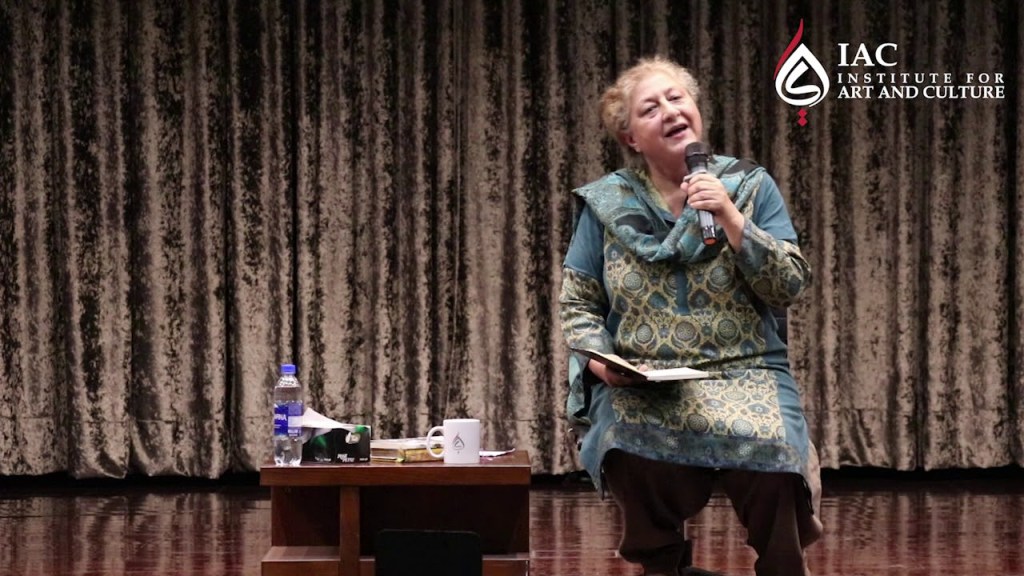
Huma Safdar is a theatre practitioner , artist, and Punjabi language activist. She studied fine arts at the National College of Arts (NCA) in Lahore, and has been working in theatre for over 30 years. A lot of her work focuses on Punjabi folklore, feminist storytelling, and community-based performance.
She has been part of the feminist theatre group Sangat and is known for staging Punjabi plays in schools, public spaces, and shrines. Her performances often revolve around characters from Punjabi classics like Heer, Sassi, and Sohni.
She also taught at Lahore Grammar School for many years, where she introduced generations of students to Punjabi language and performance.
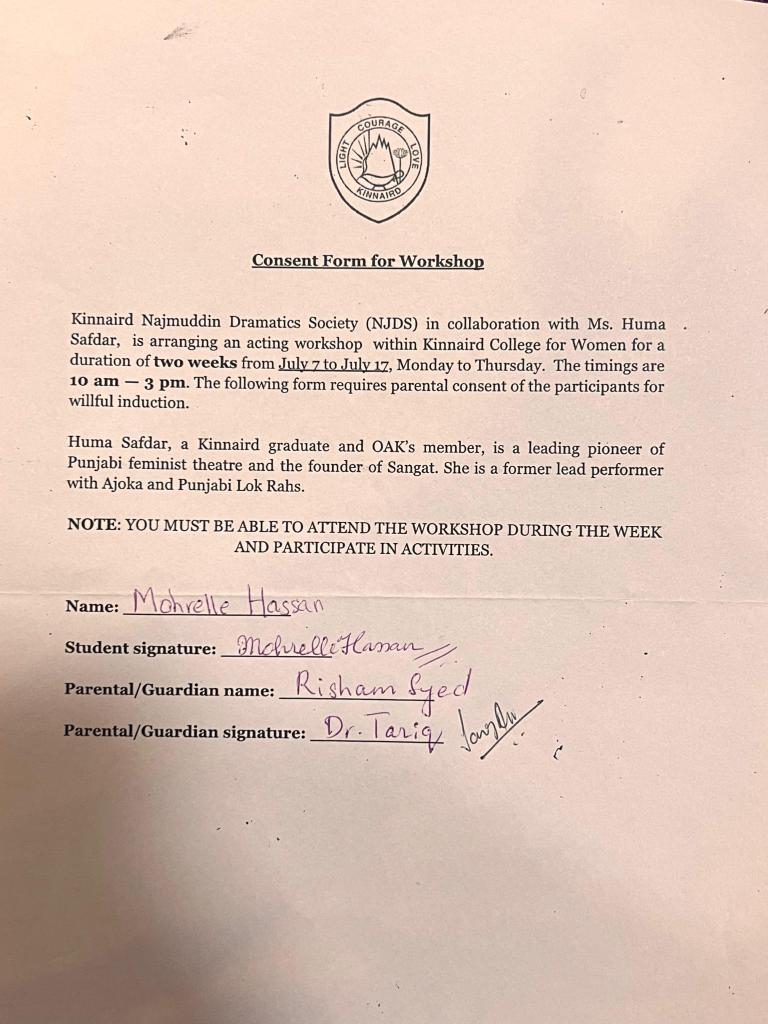
Note: Each day from Day One to Day Seven is organized as a playlist. Every playlist contains different kinds of videos documenting the exercises we did. These were intensive four-hour workshops, with each day focusing on a unique set of activities.
Day 1 – Movement & Balance
The first day of the theatre workshop at The Kinnaird College was centered around movement. It was more of an introductory session where we were encouraged to explore our bodies in space and understand movement through a series of guided exercises. The focus wasn’t on performance but on becoming aware of ourselves, of others in the room, and of the energy we create together.
We did partner based exercises that revolved around the idea of balance, not just physically, but also in terms of presence, support, and responsiveness. Some of these movements were improvisational and demanded active listening to your partner’s body language.
It felt like the day was more about, settling into the space, letting go of hesitation, and starting to connect with movement as a tool of communication. The interactive nature of the exercises helped set a tone of openness and exchange for what’s to come.
Day 2
This day was focused on sound. We experimented with how sounds are made, how they function in performance, and how they interact with movement. We tried out short sound-based scenes, worked with rhythm, and explored how beat and action can come together. It wasn’t just about making noise, but understanding how sound shapes energy, mood, and communication on stage.
There was a focus on using the voice in different ways. Theatre demands a particular kind of projection, and not everyone is used to that. Some people were more comfortable than others, and you could see how different our limitations were when it came to multitasking sound with action. At times team work really mattered, because everything needed to stay in sync.
Day 3
We focused on movement again, but with a new set of exercises. The emphasis was on responding quickly, not in a fully improvised way where you make something up entirely, but by listening closely and reacting almost instantly, within about 10 seconds. The aim was to sharpen our ability to notice, process, and act in the moment. One example involved creating a short, spontaneous “story” through movement in response to what we heard or observed.
Day 4
Before this, we worked on exercises that explored trust and letting go of control. One of the most challenging was standing on a stool placed on stage, then falling backwards in a way trusting that the people around us would catch us. It was a strange mix of fear and faith; falling without seeing who would support me forced me to rely completely on others. I tried, and while it wasn’t entirely successful, it became an important starting point.
From there, we gradually moved into other exercises such as first exploring movement, then collaboration, and then the relationship between movement and sound. Each activity built on the last, sharpening our ability to listen, respond, and remain aware of the group.
Towards the end, we began working with Giddha, a traditional Punjabi folk dance performed primarily by women. Rich in song, rhythm, and storytelling, Giddha is often performed during festivals and harvests as a celebration of community. In this context, it became more than just a cultural form; it was a way to bring together all that we had been exploring, trust, movement, rhythm, and shared expression, into one collective experience.
Alfo Perni Di Waar
play work in progress
Videos are yet to be uploaded
Please note the play is scheduled for next year 2026, Nov
It’s a 6 hour long play and rehearsals will continue for 1 year
20th Aug Onwards
Alfo Perni Di Waar, written by Najm Husain Syed and directed by Huma Safdar, isn’t just a play – it’s a confrontation with history, power, and patriarchy. At its core, it’s about bravery, but not the kind we hear in tales of kings and warriors. It’s bravery from a woman’s perspective, told by women, performed by women, and staged at Kinnaird College, an all-girls space that makes this retelling even more powerful. It was last performed at Kinnaird in 2005 and is a 6 hour long play.
Alfo Perni Di waar Day 1
Note: Each day from Day is organized as a playlist. Every playlist contains different kinds of videos documenting the rehearsals for Alfo Perni Di Waar. These are two and sometimes three hour long rehearsals.
Alfo Perni Di Waar Day 2
Alfo Perni Di Waar Day 3
Alfo Perni Di Waar Day 4
The play reimagines Dastan-e-Amir Hamza, originally penned by Maulvi Ghulam Rasool, through a feminist lens. It questions who gets to define courage, who holds power, and how exploitation and wealth concentrate in the hands of a few. It is both a critique and a reclamation, turning a grand narrative on its head.
One of the most striking figures is Mai Bhagi – a business woman selling wine turned singer and dancer who dared to defy the Maharaja when everyone else was afraid. Instead of performing for him, she narrates her own story, exposing the injustices she has faced. In that refusal, she claims her voice, her livelihood, and her agency as a woman and as an artist.
Alfo Perni Di Waar Day 5
Alfo Perni Di Waar Day 6
Alfo Perni Di Waar Day 7
Alfo Perni Di Waar Day 8
The play draws from themes already present in Dastan-e-Amir Hamza – adventure, war, love, religion, the eternal battle of good and evil but it pushes us to think deeper. What is right and what is wrong? What is just but not “politically correct”? Sometimes, it suggests, real bravery is standing against the structures that silence others, even if it comes at a cost.
Day 9
Day 10
Links that Ms Huma shared with us
https://share.google/images/ocE4zcFG5iNYmlce9
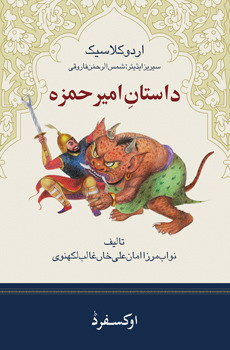
Dastan-e-Amir Hamza Collection / داستان امیر حمزہ سیریز

https://www.goodreads.com/book/show/18070204-dastan-e-amir-hamza
داستانِ امیر حمزہز [Dastane-e Amir Hamza]
https://ir.iba.edu.pk/sslace/250/
Good and Evil in Dastan-e-Amir Hamza
Analysis of Sarah Imran’s study.
As I’ve been working on Alfo Perni Di Waar, I was introduced to a study by Sarah Imran that looks at how Dastan-e-Amir Hamza understands good and evil. Reading it helped me see the backdrop against which Alfo Perni speaks, because the play is, in many ways, a response to that older text.
The analysis shows that Amir Hamza isn’t simple, it doesn’t divide the world into heroes and villains. It brings in layers of religion, morality, and power. The “true faith” is one of the strongest ideas running through it. Morality is often defined by belief, by standing with or against a particular vision of religion. Goodness and evil are tied to faith itself.
Then there is ayyari – the art of trickery. This is not just lying or deception, but a whole world of cunning, disguise, and performance. What struck me is that trickery is not always condemned. Sometimes it saves lives, sometimes it moves the story forward. It complicates what we think of as moral, showing that even in tales of good and evil, the line is never so clear.
Gender is another thing, especially masculinity. Bravery and valor are almost always framed in male terms. To be “good” or “heroic” is tied to ideals of manhood, while women are pushed to the margins of the story. That imbalance is precisely what Alfo Perni Di Waar takes up and turns inside out.
So while Amir Hamza dazzles with its adventures, wars, and moral battles, it also carries within it the structures that silence women. And this is why Alfo Perni Di Waar feels so powerful – it doesn’t just critique from outside, it enters the same conversation and reclaims bravery, faith, and storytelling for women’s voices.
What Sarah Imran shows in her study of Dastan-e-Amir Hamza– that good and evil are never straightforward. In one scene, Alfo enters the masjid with the child of a pig. By religious logic, this act is unthinkable, yet the Maulana sahib chooses compassion: he brings milk for the piglet and lets Alfo stay the night. The next morning, when he is condemned, he accepts the criticism but still defends his decision. That one moment shows how morality can shift when it is grounded in care rather than rules.
The same happens when Mai Bhagi confronts the dying Maharaja. She refuses to dance for him, instead forcing him to listen to her own story. Her bravery is not about war or conquest, but about refusing to be silenced. And in the scene with the Pandit and his workers, even food becomes a stage for power where separate meals for the privileged, langar for the rest.
These scenes echo what Sarah describes in Amir Hamza: faith, trickery, hierarchy, and morality are always in negotiation. But in Alfo Perni Di Waar, the negotiation shifts to the voices of women, workers, and the marginalized – those who rarely get to define what bravery or goodness means.
Composite armor in the Hamzanama, commissioned by mughal emperor Akbar 1557-1577,India.
https://share.google/w5UVsXa5v11EauaFX

Hamzanama #2 is a painting by Akbar which was uploaded on October 21st, 2020.
https://share.google/Vlbf3d3ZSBavfqyBi

https://share.google/RrxLb2EZsOll0wKlK

Please note that while this blog is for official purposes, I will continue updating it over the course of the year, as rehearsals are long and ongoing. For now, I’d like to pause here with a reflection on the stories that inspire our work.
Alfo is a gypsy girl, tomboyish and brave, who risks her life to save a tiny piglet. This small act of empathy moves Moulvi Ghulam Rasul as she enters the mosque where he is translating Dastan Amir Hamza from Persian into Punjabi – a story of a warrior king, chivalry, and the right to kill in the name of justice. Alfo Paini Di Var tells us how the Dastan was written, rewritten, and translated over centuries – from Mehmud Ghaznavi’s Persian version, to Akbar’s illustrated text, to the British Urdu edition, and finally to Ghulam Rasul’s Punjabi translation. While the epic tells the story of kings and power, Alfo’s story shows ‘Ghareeb Hamza’ – a hero of the people resisting injustice from as far back as the 5th century.
Histories are written to give a perspective on the past, shaping how we understand ourselves and our actions. But then the question arises: who is telling the story, and who is it being told to? Alfo Paini Di Var challenges the histories written by rulers, bringing forward the unwritten stories of resistance and offering a feminine perspective.
In this way, history is never one-sided. It is lived, retold, and reinterpreted, just as the stories we are bringing to life on stage today.
Instagram page for the play
https://www.instagram.com/alfo_kinnaird?igsh=MTRqZDJzMnUyOHBqaQ%3D%3D&utm_source=qr
 Reflections in Practice
Leave a comment